Ideals Board Review
Ideals Board is the board management platform from Ideals Solutions Group, the same company behind the Ideals Virtual Data Room. It helps boards, committees, and executives manage meetings, documents, and decisions in a central portal, with a strong emphasis on usability and security.
This Ideals Board review explores the product’s core strengths and where it’s best suited.
What is Ideals Board?
Ideals Board is a board management software designed for nonprofits, corporations, and government bodies, offering a secure workspace for meeting management, document collaboration, and voting. Organizations requiring high-level compliance (GDPR, HIPAA, SOC 2) use Ideals because they recognize it for its transparent, all-inclusive pricing model and ease of use.
Contacts
| Name: Ideals Board | Website: idealsboard.com |
| Founded: 2013 | Headquarter: United States |
Best-suited applications for Ideals Board portal
Ideals Board best suits organisations that want one secure place to manage board packs and meeting records with customizable access controls and a reliable audit trail.
- Australian nonprofits and registered charities
- ASX-listed and pre-IPO companies
- Local councils and public-sector bodies
- Hospitals, health networks, and aged-care providers
- Education groups across schools, TAFEs, and universities
- Multi-entity organisations with shared governance
- Committees with recurring reporting cycles.
Ideals Board features overview
Ideals Board software brings the main parts of board work together in one secure place. It aims to make meetings easier to plan, run, and follow up.
- End-to-end board governance platform
- Web-based access on all modern browsers
- iOS and Android mobile apps
- Ideals Board integrations with Calendar for Outlook and Google
- Video meeting links for Zoom or Teams
- Works across desktop, tablet, and mobile
- Easy onboarding for new users
- Scheduler for planning board and committee meetings
- Agenda builder with templates
- Board book viewer with live updates
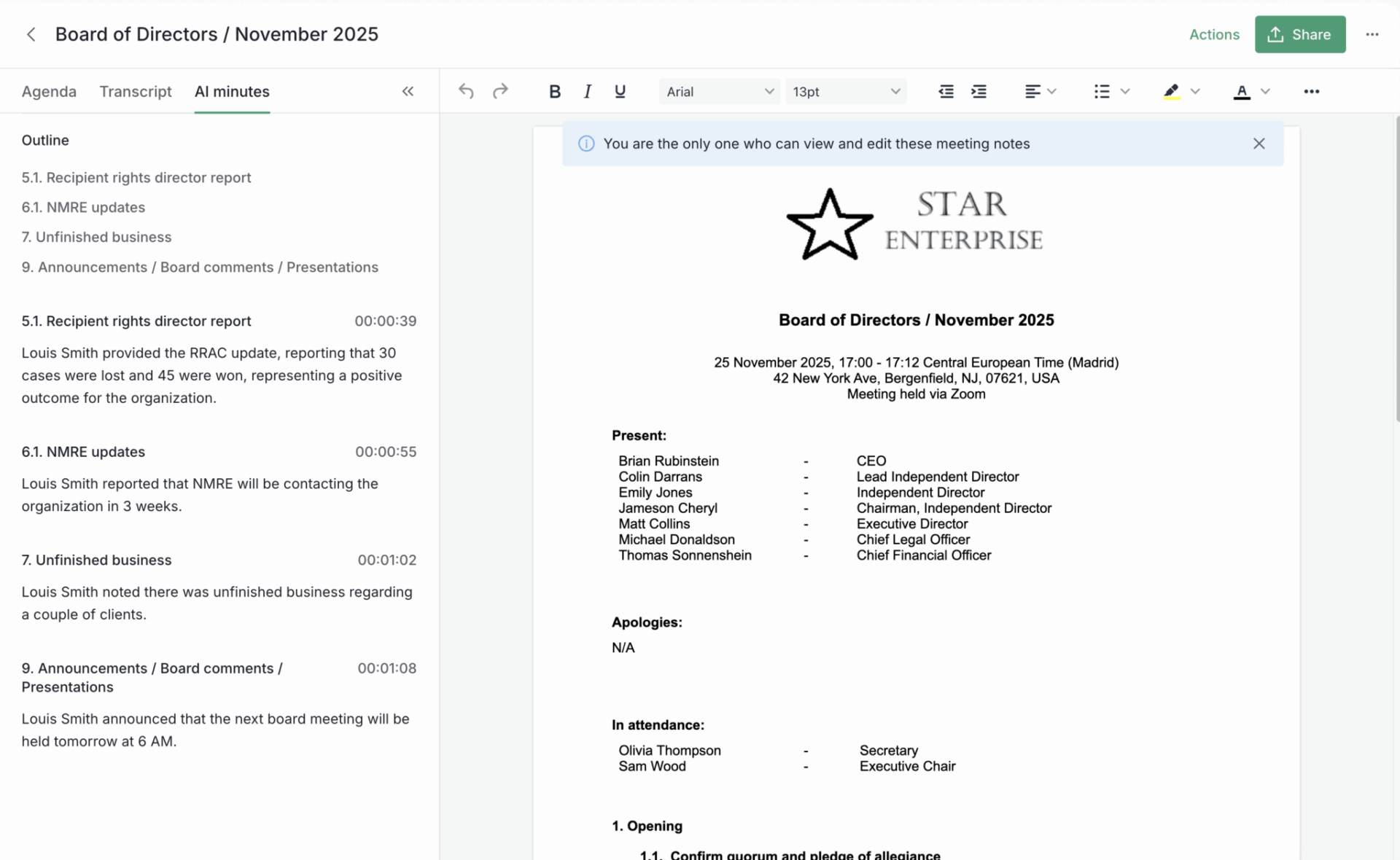
- Meeting minutes editor
- Voting for resolutions and approvals
- Tasks linked to meeting outcomes
- Dashboard with upcoming meetings and key items
- Automatic reminders for members
- ISO 27001, ISO 27701, ISO 27017
- SOC 2, SOC 3
- GDPR, HIPAA compliance
- Single sign-on (SSO)
- Two-factor authentication (2FA)
- Role-based permissions
- Detailed audit trails
- SecurityScorecard 99/100
- UpGuard 948/950
- Documents library for board documents
- Role-based access to sensitive files
- Global search for past agendas and minutes
- Notes and private annotations in board packs
- Real-time updates to documents and meeting packs
- Shared view mode during discussions
- Smooth access through mobile apps
- Integrations that reduce switching between tools
Australian market considerations
Ideals Board’s global security certifications support Australian compliance obligations, but they do not automatically satisfy every local requirement. Each framework below applies to a different sector named in Best-suited applications, so a board should check its own obligation against the matching standard rather than relying on the global certification list alone.
Under the Privacy Act 1988, overseen by the Office of the Australian Information Commissioner, any organisation handling personal information must meet the Australian Privacy Principles. These principles cover how personal information is collected, stored, used, and disclosed, and they apply regardless of an organisation’s size or sector.
Ideals Board’s GDPR compliance addresses a comparable set of data-handling obligations, since both frameworks require clear consent, defined retention periods, and accountability for how personal data moves through a system. Even so, Australian boards should confirm data residency and breach-notification procedures directly with the vendor, since GDPR and the Privacy Act are separate frameworks with their own specific requirements and timelines.
Registered charities and nonprofits fall under the ACNC Governance Standards, which require transparent record-keeping and accountable board-level decision-making. The standards also expect a charity’s responsible people to understand their duties and to manage conflicts of interest appropriately.
Ideals Board’s audit trail and role-based permissions support the documentation these standards require, since every access and approval is logged automatically rather than tracked manually. Governance responsibility, however, stays with the board rather than the software.
ASX-listed and pre-IPO companies operate under the ASX Corporate Governance Council Principles and Recommendations, which call for clear board oversight of risk management and disclosure, currently in their fourth edition, with a fifth edition under public consultation. Ideals Board’s SOC 2 and SOC 3 certifications cover the security controls behind that oversight, providing listed companies with independently audited evidence to reference during disclosure reviews, rather than an internal, unverified claim.
Financial-services boards, including credit unions, sit under a related but distinct set of prudential expectations; see our board management software for credit unions guide for how APRA and ASIC obligations apply in that sector specifically.
However, none of these certifications replace legal advice. They give Australian boards a documented starting point for assessing whether Ideals Board fits their specific regulatory obligations, rather than a final answer on compliance.
Healthcare and aged-care compliance
Hospitals, health networks, and aged-care providers face obligations beyond the Privacy Act. The Aged Care Quality and Safety Commission’s Aged Care Quality Standards require documented governance oversight of care delivery, while most states and territories add their own health-records requirements.
Boards in these sectors should confirm that Ideals Board’s permission controls can separate board-level oversight material from operational clinical records, as the two may have different access and retention requirements.
Its audit trail provides evidence of who viewed or approved a document, but it does not replace a sector-specific information-governance policy.
Education sector record-keeping and data protection
Schools, TAFEs, and universities also operate under layered requirements. Each state and territory sets record-keeping rules for governing bodies alongside federal Privacy Act obligations.
The Notifiable Data Breaches scheme, administered by the Office of the Australian Information Commissioner, can also require a documented response when protected board or student data is exposed. Ideals Board’s permissions and activity logs can help demonstrate who accessed what and when, providing useful evidence during a breach response.
The response plan itself still needs to be written and tested separately.
Ideals Board pricing
Ideals Board provides a single annual subscription per user. The same core feature set is available to all customers. Additionally, registered nonprofits receive at least a 20% discount, and larger organisations can negotiate volume savings. The site does not show exact licence numbers, but a sales representative can provide a personalized quote.
In practice, the Ideals Board pricing model looks like this:
- Annual subscription, priced per user
- One main plan rather than several tiers
- Minimum 20% discount for nonprofits
- Volume discounts for larger teams
- Free trial plus sales-led proposal
Ideals Board use cases
Most organisations use Ideals Board software to replace multiple tools with a single, auditable platform. Typical use scenarios include the following:
- Recurring board meetings. Run agendas, board packs, and decisions in one workspace for each meeting.
- Committees and sub-committees. Give audit, risk, finance, and other committees a consistent way to handle papers, minutes, and follow-up.
- Remote and hybrid governance. Let directors review documents, add notes, and vote from the Ideals Board app or browser, regardless of location.
- Policy and document management. Keep policies, charters, and past minutes in a single library so board members can find what they need.
- Decisions and follow-up tracking. Link minutes, voting records, and tasks to each meeting so executives can see what was approved and what remains open.
- Multi-entity and group governance. Support several boards or advisory groups while keeping each group’s documents and access separate.
Pros & Cons
When you compare Ideals Board pros and cons against another company’s tools, keep your own constraints in mind. A perceived limitation for one organisation may be acceptable or helpful for another.
| Advantages | Limitations |
| – Precise document control with granular permissions – Clear agenda and board pack workflow – Linked decisions, minutes, and tasks that keep follow-up visible – Strong and quick customer support – Intuitive UI and quick user adoption | – No standardised price list; every deal requires a quote – Focused on board and committee use, less for general project work – Lower volume of public Ideals Board reviews than long-established competitors – Advanced AI features still evolving and fairly new |
Key takeaways
- Ideals Board software is a secure board and committee portal backed by a mature VDR vendor.
- The Ideals Board pricing model is simple: one per-user plan, annual billing, nonprofit, and volume discounts.
- Security certifications and AWS hosting give confidence for regulated sectors.
- The Ideals Board app and browser access support remote and hybrid governance.
- The feature set covers agendas, board packs, votes, minutes, tasks, and document storage in a single Ideals Board portal.
- Organisations should compare Ideals Board alternatives on data residency, analytics depth, and training needs.
- For nonprofits, councils, health services, and education bodies, Ideals Board is a realistic, mid-market option rather than a niche tool.
- Weighing Ideals Board against named alternatives: compare with Diligent Boards for enterprise-scale governance and risk management, or see Our Cat Herder for a lighter-weight option aimed at smaller nonprofit boards.
FAQ
Ideals Board includes built-in voting for resolutions and approvals, linked directly to the relevant agenda item and meeting record. Tasks generated from a vote or decision carry through to follow-up tracking, so directors can see what was approved and what action remains outstanding. Voting sits inside the same meeting management workflow as the agenda builder and minutes editor, rather than as a separate add-on module, keeping the full record of a decision in one place instead of split across several tools.
Ideals Board supports ISO 27001, ISO 27701, and ISO 27017, as well as SOC 2, SOC 3, GDPR, and HIPAA compliance, plus two-factor authentication, role-based permissions, and detailed audit trails that log every document and meeting action. For Australian nonprofits, ASX-listed companies, and other regulated sectors, these controls map to specific local obligations covered in the Australian market considerations section above, including the Privacy Act 1988, ACNC Governance Standards, and ASX Corporate Governance Council Principles.
The exact Ideals Board cost is not public. The vendor uses a personalized annual per-user model with discounts for nonprofits and larger teams. Australian buyers need a quote based on user numbers and governance structure.
Yes, the vendor advertises a minimum 20% saving for registered nonprofits globally, including Australian charities, using the same secure feature set as commercial customers.
Recent product updates introduced AI minutes for automatic meeting summaries, alongside existing automated minutes templates, tasks and linked decisions to streamline documentation.
Yes, Ideals Board integrates with Outlook and Google calendars, and lets directors join meetings through tools like Zoom or Microsoft Teams directly from the agenda or meeting invitations.
Yes, Ideals markets the portal heavily to nonprofits, health services, and public bodies. For example, councils, education, and regulated financial services use case-style content and comparison guides.